

Restorative Justice & Youth Justice Conferencing Queensland
Experienced Legal Advice for Conferencing, Diversion & Non-Court Outcomes
If you or your child has been referred to a restorative justice conference or youth justice conference, it is important to obtain legal advice early.
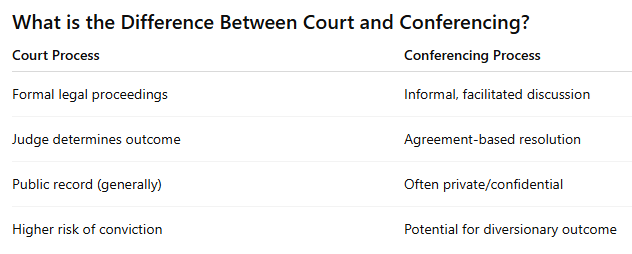
These conferencing processes can significantly impact the outcome of a criminal matter, including whether charges proceed, are diverted, or resolved without a formal court conviction.
At Robinson Law, we provide strategic advice and representation for both adult restorative justice conferencing and youth justice conferencing matters across Queensland.
What is Restorative Justice Conferencing in Queensland?
Restorative justice conferencing is a structured process where an offender, victim, and facilitator come together to discuss the offence and its impact.
The goal is to:
Repair harm caused by the offence
Encourage accountability
Reach a mutually agreed outcome
Avoid or reduce the need for traditional court proceedings (in suitable cases)
Restorative justice conferencing may be considered at different stages of the criminal process depending on the offence and circumstances.
What is Youth Justice Conferencing in Queensland?
Youth justice conferencing is a diversionary process used for young people (under 18) who have been charged with or admitted to an offence.
It is designed to:
Keep young offenders out of the formal court system where appropriate
Encourage responsibility and rehabilitation
Involve victims in a structured and supervised resolution process
Reduce the likelihood of reoffending
Youth justice conferencing is commonly used in matters involving first-time or lower-level offending.
What Happens in a Restorative Justice or Youth Justice Conference?
While each case is different, conferences generally involve:
A trained facilitator
The offender and their support person (if applicable)
The victim or their representative (where they choose to participate)
Discussion about the offence and its impact
Agreement on outcomes or “conference agreements”
Possible outcomes may include:
Written apologies
Financial restitution
Community-based undertakings
Counselling or educational programs
Behavioural commitments
What Types of Offences May Be Eligible?
Eligibility depends on the seriousness of the offence, the circumstances, and prosecutorial discretion.
These conferences may be considered for:
Property offences
Minor assault matters
Public order offences
Youth offending matters
First-time or lower-level criminal offences
Serious indictable offences are less likely to be referred, but eligibility can vary.
Benefits of Restorative Justice Conferencing
Participation in conferencing may:
Reduce the likelihood of a conviction
Influence sentencing outcomes positively
Demonstrate remorse and accountability
Provide an opportunity to repair harm
Support diversion away from court proceedings (especially for youth matters)
However, outcomes are not guaranteed and legal advice is essential before participating.
Do I Have to Admit the Offence to Attend a Conference?
In most cases, participation in restorative justice or youth justice conferencing requires some level of admission or acceptance of responsibility.
However, the legal implications vary depending on the stage of proceedings. You should always seek legal advice before agreeing to participate.
Will a Conference Affect My Criminal Record?
This depends on the outcome:
Successful conferencing may result in no further action or diversion
In some cases, matters may still proceed to court
For youth matters, outcomes may not always result in a formal conviction
Each case is assessed individually.
Can I Refuse to Attend a Conference?
Yes, participation is generally voluntary in adult restorative justice conferencing. However, refusing may affect how your matter proceeds in court or sentencing considerations.
Youth conferencing referrals may be handled differently depending on the stage of the process.
Should I Have a Lawyer at a Conference?
Yes. Having a lawyer can assist you to:
Understand your rights and obligations
Prepare for the conference process
Ensure any agreement is fair and appropriate
Avoid unintended admissions or consequences
Protect your long-term legal interests
How Robinson Law Can Help
We provide advice and representation for:
Adult restorative justice conferencing
Youth justice conferencing matters
Pre-conference legal strategy
Court outcomes following conferencing
Negotiations with police and prosecution
Our focus is achieving the best possible outcome while protecting your rights at every stage.
Speak with a criminal defence lawyer
📞 1300 544 444
Available 24/7
belinda@robinsonlaw.au
faq
-
It is a structured process where an offender and victim discuss the impact of an offence and attempt to reach an agreed resolution outside of court.
-
It is a diversion program for young offenders that aims to resolve matters through accountability and rehabilitation rather than formal court proceedings.
-
No, participation is generally voluntary, but refusing may affect how your case is handled in court.
-
Yes. Legal advice ensures you understand the implications of participation and any agreements made.
-
In some cases, successful conferencing may lead to diversion or reduced court consequences, but outcomes depend on the circumstances.
-
Failure to comply may result in the matter returning to court or further legal consequences.
resources
You may also want to learn about:
Contact us.
Trust Robinson Law to provide you with prompt, relevant and helpful legal advice 24 hours a day, 7 days a week, 365 days a year.